Christians used to believe that thunder storms and lightning bolts were directed by God to “discipline his servants and teach us important lessons,” or they were directed by Satan (“the Prince of the Power of the Air”) and his demons, or they were called forth by “witches” to “try and destroy God's holy sanctuaries and ministers.” Such “sacred” explanations were vouched for by leading Christian authorities. For instance, the Catholic theologian, Thomas Aquinas wrote, “It is a dogma of faith that demons can produce winds, storms, and rains of fire (lightning) from heaven.” While, Pope Gregory XIII advocated “exorcising the demons” who “do stir up the clouds.” The Protestant theologian, Martin Luther supported the superstition even more zealously, asserting at times his belief that the winds themselves are only good or evil spirits, and declaring that a stone thrown into a certain pond in his native region would cause a dreadful storm because of the devils kept prisoners there.
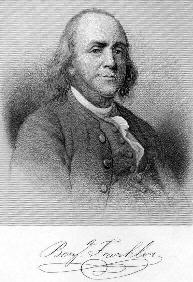
Numerous pious authors also testified how well the old “sacred” remedies succeeded in protecting churches and cathedrals from the ravages of lightning strikes and storms. Such “sacred” remedies included ringing church-bells and reciting special prayers. Hence, when Benjamin Franklin invented his “lightning rod” in 1752, most Christians were far from eager to place a “rod of iron” designed by an “arch-heretic” at the top of their churches near the holy cross of Christ. Neither did they desire to abandon the ancient Christian game of praising God (or blaming the devil), for lightning strikes and storms.
In America the earthquake of 1755 was widely ascribed, especially in Massachusetts, to Franklin's rod. The Rev. Thomas Prince, pastor of the Old South Church, published a sermon on the subject, and in the appendix expressed the opinion that the frequency of earthquakes may be due to the erection of “iron points invented by the sagacious Mr. Franklin.” He goes on to argue that “in Boston are more erected than anywhere else in New England, and Boston seems to be more dreadfully shaken. Oh! There is no getting out of the mighty hand of God.”
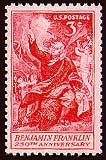
1752 Lightning Rod
On June 15, 1752, Benjamin Franklin (1706-1790) discovers the electrical nature of lightning by flying a kite in a thunderstorm. The kite has a wire conductor, a key at the end of its wet twine kite string, and a silk insulator which Franklin keeps dry by standing in a doorway. He sends his friends in London a paper entitled “Experiments and Observations in Electricity Made at Philadelphia.” In September 1752, he equips his house with a lightning rod, connecting it to bells that ring when the rod is electrified. The lightning rod when placed at the apex of a barn, church steeple, or a house, conducts lightning harmlessly into the ground and prevents fire in electrical storms. In 1752, Franklin also founded the first American fire insurance company. The 1956 postage stamp honors the 250th anniversary of Franklin's birth. It shows an elder Franklin assisted by allegory of youth in his famous kite experiment.
—
www.wisdomportal.com/Dates/1752Jupiter.html
Three years later, John Adams, speaking of a conversation with a Boston physician, says, “He began to go on about the presumption of erecting iron rods to draw the lightning from the clouds. He talked of presuming upon God, as Peter, attempted to walk upon the water, and of attempting to control the artillery of heaven.”
As late as 1770 many religious Americans still felt that, since thunder and lightning were tokens of the divine displeasure, it was impiety to prevent their doing their full work. It took a few decades for the devout to abandon their religious prejudices regarding the use of the lightning rod, but eventually it was demonstrated to all but the most dense that both the “vengeance of God” and the “Prince of the Power of the Air” were forced to retreat before the lightning-rod of a heretic.
- A. D. White, A History of the Warfare of Science with Theology & E.T.B.
Churches in Germany shunned Franklin's new invention for three decades, during which time some 400 church towers were damaged by lightning and 120 bell ringers killed. In one church a bolt of lightning struck the tower and melted the bell, electrocuted the priest, deprived a parishioner of her sensibilities and destroyed a painting of the Savior. Church towers, being the highest structures in a village, are commonly struck by lightning, while brothels and saloons next door escape untouched.
- William Deitz, Creation/Evolution Satiricon
It was long before the churches consented to be protected by the heretical tool. The tower of St. Mark's in Venice had at the time of Franklin's invention been struck again and again by lightning, sometimes with such disastrous effects that it had been almost destroyed. The Almighty, or alternatively the Powers of Darkness, seemed to have singled it out for special punishment, in spite of the angel that adorned its summit, the consecrated bells which were repeatedly rung to drive away the thunder, the holy relics in the cathedral nearby and the processions of the Virgin and the patron saint. The tower was struck again in two successive summers, whereupon the authorities succumbed and a lightning rod was erected. The edifice has never been damaged by lightning since, but God alone has received the thanks of a grateful people. In Austria the church of Rosenberg was struck so frequently and with such loss of life that the peasants feared to attend services. Three times the spire had to be rebuilt, until the devil was exorcised by an iron rod. Such was also the history of St. Bride's and St. Paul's in London, the cathedrals of Sienna and Strasburg and of other churches throughout Europe and America; they were protected only after it was evident that not to do so was to lay them open to repeated injury.
- Homer W. Smith, Man and His Gods (Boston: Little Brown and Co., 1952)
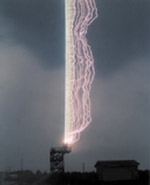
The case which did the most to convert the Italian theologians to the scientific view of lightning and the use of the lightning rod was that of the church of San Nazaro, at Brescia. The Republic of Venice had stored in the vaults of this church over two hundred thousand pounds of gunpowder. In 1767, seventeen years after Franklin's discovery, no rod having been placed upon it, it was struck by lightning, the powder in the vaults was exploded, one sixth of the entire city destroyed, and over three thousand lives were lost.
Examples like that had their effect. The formulas for conjuring off storms, for consecrating bells to ward off lightning and tempests, and for putting to flight the powers of the air, were still allowed to stand in the liturgies; but the lightning-rod, the barometer, and the thermometer, carried the day.
- A. D. White, A History of the Warfare of Science with Theology & E.T.B.
Ben Franklin's life-saving invention, the lightning rod, was condemned by many Christians as an insult to Almighty God, or at least, to his aim. Because the Bible says God “sends forth lightnings...He covers His hands with the lightning. And commands it to strike the mark. Its noise declares His presence?Under the whole heaven He lets it loose, And His lightning to the ends of the earth... Whether for correction, or for His world, Or for loving kindness, He causes it to happen.”
[Job 36:27-33 & 37:1-13 & 38:35]
And Ben Franklin sang, “Nya, nya-nya, nya, nya. Can't hit me!”
- E.T.B.
THE HERETICAL WISDOM OF THE INVENTOR OF THE LIGHTNING ROD
Lighthouses are more helpful than churches. [I later discovered this quotation is spurious, but it’s likely that it came from a letter he wrote to his wife in July 1757, after he narrowly escaped a shipwreck off the British coast: “The bell ringing for church, we went thither immediately, and with hearts full of gratitude [for not having shipwrecked], returned sincere thanks to God for the mercies we had received. Were I a Roman Catholic, perhaps I should on this occasion vow to build a chapel to some saint; but as I am not, if I were to vow at all, it should be to build a light-house.”]
Original sin is as ridiculous as imputed righteousness.
As to Jesus, I have some doubt as to his divinity.
- Benjamin Franklin, quoted in Benjamin Franklin: His Wit, Wisdom, and Women by Seymour Stanton Block